How AI-Native Mobile Apps Are Changing Business in 2026?
- April 6, 2026
- 9 mins
- 5.4k
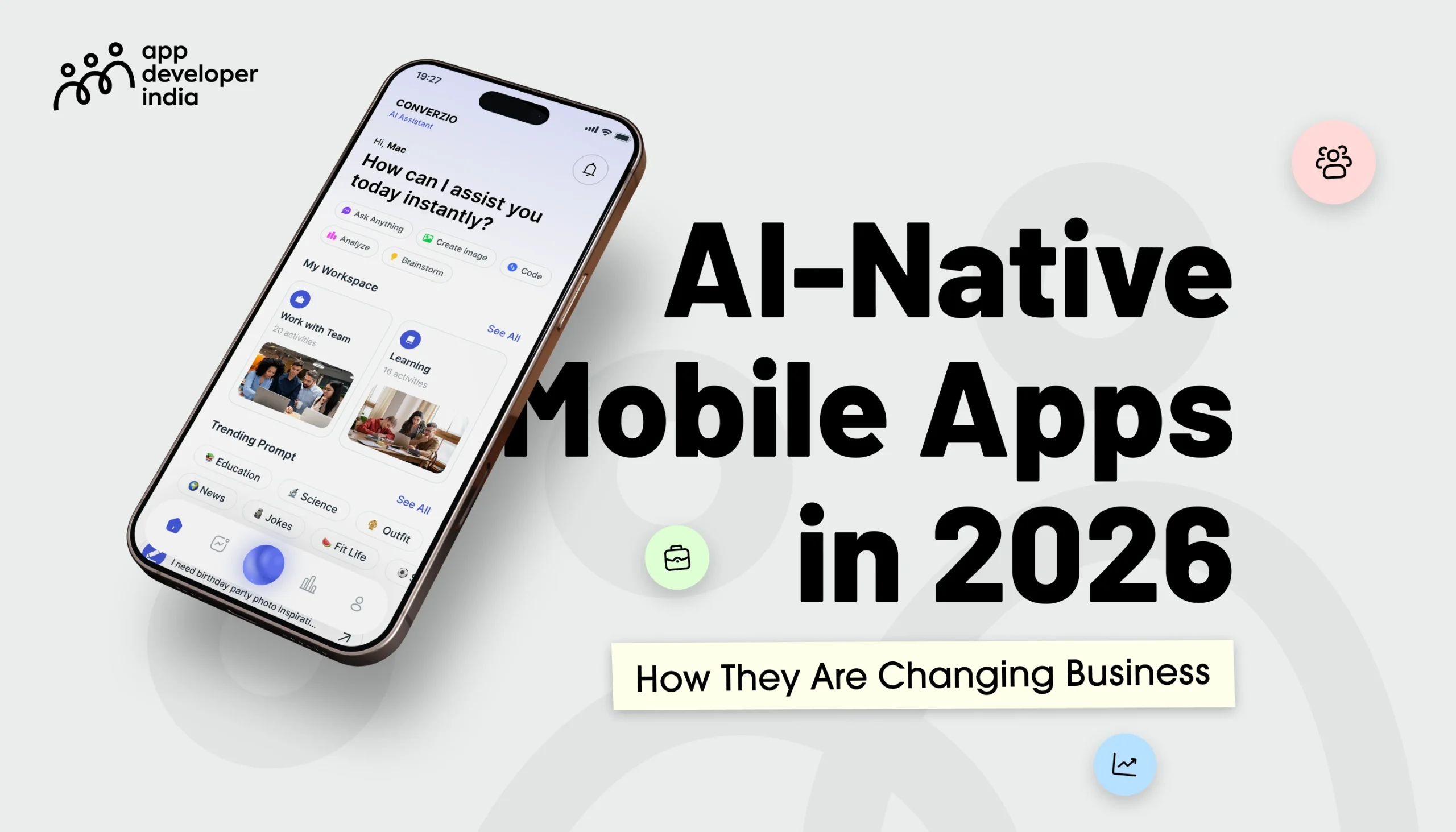

Mobile apps aren’t just tools anymore. In 2026, they’re closer to decision systems.
What’s changed? The foundation. Businesses are no longer building apps that wait for user input. They’re building AI-native mobile apps that observe, learn, and act in real time. Open an app today, and it already knows what you’re likely to do next. Not by guesswork, but by patterns it has been quietly tracking.
Recommendations feel sharper. Workflows move faster. Predictions show up before the problem does. This is where AI-powered apps for business start to look less like software and more like operational intelligence.
A few years ago, most apps followed fixed logic. Tap this get that. Now the logic evolves. The app adjusts based on behavior, context, even timing. It’s subtle but the impact is massive.
That’s why companies are doubling down on AI mobile app development 2026 strategies. Not for experimentation, but for survival. Static experiences don’t hold attention anymore. Users expect relevance, speed, and context without asking for it.
So the shift isn’t just technical. It’s behavioral. Businesses are moving from building features to building systems that think.
Let’s look at what that actually means in practice.
What Makes an App “AI-Native”?
Unlike traditional apps where AI is added later as a feature, AI-native mobile apps are built with intelligence at their core.
These apps-
- Continuously learn from user behavior
- Adapt interfaces and responses dynamically
- Make predictions instead of just reacting
- Automate decisions using real-time data
Think of it this way- traditional apps follow instructions. AI-native apps evolve.
This is why businesses are shifting toward AI-powered apps for business because static logic is no longer enough in a fast-changing digital environment.
How AI Is Transforming Mobile Apps?
The biggest change is not just technological it’s functional.
Earlier, apps required users to navigate, search and input everything manually. Now, with how AI is transforming mobile apps the experience is becoming intuitive and predictive.
Here’s how-
- Hyper-Personalization at Scale
Apps now analyze user behavior, preferences and history to deliver highly personalized experiences. Whether it’s content products, or services everything feels tailored.
- Real-Time Decision Making
AI enables apps to process data instantly and make decisions without human intervention. This improves speed efficiency & accuracy.
- Voice and Conversational Interfaces
AI-driven chatbots and voice assistants are becoming standard AI features in mobile apps, enabling natural interaction instead of rigid navigation.
- Predictive Analytics
Apps can now predict what users need before they even ask from purchase suggestions to health insights and service alerts.
- Automation of Workflows
Routine tasks like scheduling, customer support & notifications are automated, reducing manual effort and operational costs.
This shift is why the future of mobile apps with AI is less about usage and more about intelligent assistance.
Why Businesses Are Investing in AI Mobile Apps in 2026?
The demand for AI app development services has surged and for good reason.
Businesses are no longer asking if they should adopt AI. They’re asking how fast they can implement it.
Here’s what’s driving this investment-
Competitive Advantage
Companies using machine learning mobile applications can analyze user behavior faster and respond smarter than competitors.
Increased Customer Retention
Personalized experiences lead to higher engagement. When apps understand users better, users stay longer.
Operational Efficiency
AI reduces dependency on manual processes, lowering costs and improving productivity.
Data-Driven Decisions
Instead of guessing, businesses rely on real-time insights generated by AI systems.
Scalable Growth
AI allows apps to handle large volumes of users and data without proportional increases in resources.
Simply put, benefits of AI in mobile apps are no longer optional they’re essential for growth.
Industries Leading the AI App Revolution
AI adoption is not limited to one sector. It’s transforming multiple industries at once.
Healthcare
AI apps assist in diagnosis, patient monitoring & medical documentation, improving accuracy and saving time.
E-commerce
From product recommendations to dynamic pricing, AI is driving conversions and customer satisfaction.
Finance
Fraud detection, credit scoring & personalized financial advice are powered by AI.
Fitness & Wellness
Apps analyze user habits, nutrition & activity to provide personalized health plans.
Logistics & Mobility
Route optimization, demand prediction & fleet management are being handled by AI systems.
These examples show how AI-powered apps for business are solving real-world problems across industries.
Read More: When Should You Hire a Dedicated Developer Instead of Building an In-House Team?
Technologies Behind AI Mobile App Development
Building intelligent apps requires a combination of advanced technologies.
Key components used in AI mobile app development 2026 include-
- Machine Learning (ML) for pattern recognition and predictions
- Natural Language Processing (NLP) for chatbots and voice assistants
- Computer Vision for image and video analysis
- Cloud AI platforms for scalability and processing power
- Data Analytics tools for insights and optimization
These technologies work together to power AI features in mobile apps that feel seamless to users.
Cost and Complexity- Is AI App Development Expensive?
One common concern businesses have is cost.
The reality is- AI-native apps can be more expensive initially, but they deliver long-term ROI.
Costs depend on-
- Complexity of AI features
- Data requirements
- Integration with existing systems
- Development timeline
However, with modern frameworks and pre-trained models, AI app development services are becoming more accessible, even for startups.
Many businesses now start with a focused AI feature and scale gradually reducing upfront investment.
Building AI Mobile Apps for Business Growth
If you’re planning to build AI mobile app for business, the approach matters.
Here’s a simplified roadmap-
- Identify a clear use case (personalization, automation, prediction)
- Choose the right AI technologies based on goals
- Start with a Minimum Viable Product (MVP)
- Train models using relevant data
- Continuously improve based on user behavior
The key is not to overcomplicate but to solve real problems with intelligent solutions.
Challenges in Developing AI-Native Mobile Apps
While the opportunities are massive, there are challenges businesses must consider-
- Data availability and quality
- Model accuracy and bias
- Integration with legacy systems
- Privacy and security concerns
- Need for skilled AI developers
Despite these challenges, the long-term benefits far outweigh the initial hurdles.
The Future of AI in Mobile Apps
Looking ahead, the evolution of AI-native apps will accelerate even further.
We’re moving toward-
- Fully autonomous apps that act without prompts
- Context-aware experiences based on environment and behavior
- AI agents embedded within apps for task execution
- Continuous learning systems that improve over time
The future of mobile apps with AI is not just smarter apps it’s smarter businesses.
Final Thoughts
AI-native apps are reshaping the way businesses work behind the scenes. Things that used to depend on teams and time & large labor inputs are now removed from human interaction through systems that think and adapt on their own.
Data is no longer just presented by mobile apps in 2026, predictions & user interaction are executed directly on the app layers. This shift is transforming the way companies take care of customers, workflows & growth.
For 2026, businesses investing in AI mobile app development are not doing this just as a fad or trend. They are addressing many real world inefficiencies, increasing response time & building systems that scale seamlessly.
It’s not just smarter apps that make the real difference. It’s more intelligent execution across the company.
Stop Building Features. Start Building Intelligence
Shift from static functionality to adaptive AI systems that continuously improve user experience and business performance.
Frequently Asked Questions
You don’t need to rebuild your app from scratch. Most businesses start by layering AI into specific workflows. Think recommendation engines, chat support, or behavior tracking. APIs and cloud AI services make this easier than it used to be. For deeper use cases, custom models trained on your own data unlock better results. Start small. Expand where it actually moves the needle.
At its core, an AI-native app doesn’t wait for instructions. It anticipates. You’ll see real-time personalization, predictive suggestions, automated decision-making & interfaces that respond to voice or natural language. The defining trait is learning. The app improves with every interaction, not after a manual update cycle.
There’s no fixed timeline, but most projects land somewhere between three to nine months. A basic AI feature can go live quickly. A fully AI-native product takes longer due to data training, testing & refinement. The more intelligence you expect, the more iteration you’ll need. Speed comes from clarity, not shortcuts.
This isn’t a one-role job. You need mobile developers to build the interface, AI and ML engineers to handle the models & data specialists to make sense of inputs. Add UI/UX designers to keep it usable and cloud experts to scale it. AI apps fail less because of code, more because of poor collaboration between these roles.
Absolutely. AI is no longer reserved for large enterprises with deep pockets. Small businesses can use pre-built models for personalization, automation, or customer insights without massive investment. The advantage is focus. Solve one problem well, like reducing churn or improving conversions & the returns show up quickly.
The hardest part isn’t writing code. It’s getting the data right. Poor data leads to poor predictions. Then comes model accuracy, integration with existing systems & maintaining user trust around privacy. There’s also a talent gap. Skilled AI professionals are in demand, which can slow things down if you don’t plan ahead.
Retention improves when apps stop feeling generic. AI tracks behavior, learns preferences & adjusts experiences in real time. Users get relevant suggestions, faster support & fewer friction points. Over time, the app feels familiar. Not because it looks good, but because it understands what the user actually wants.
Recent Blogs
Stay ahead with the latest tech trends with our informative blogs and
insider guide to hire the best talent.